Sep 20, 2026
The Map and the Burden
We do not engage reality directly. We engage it through an apparatus — a working model of what matters, what the stakes are, and how to respond. Call it a map.
Most of what looks like stupidity or bad faith in other people is not either. It is a map built for one territory being run on a different one, rendering beautifully the whole time.
This is an essay about why those maps are so hard to correct, where the one available opening is, and what happens when a particular map — the one we learned from machines — gets applied to people.
The map is an apparatus
What separates a map from a pile of facts is that a map has a scale, a projection, and a use. Those three things make it usable, and they are also what make it wrong in specific, chosen ways.
Which gives the first useful consequence: the distortion is the feature. A subway map is topologically correct and geographically a lie. That is not an error — it is fitness for purpose. You cannot walk the city with it and you can ride the system perfectly.
So “is this map true?” is the wrong question. The right one is: what is this map for, and am I currently using it for that?
Korzybski’s line is the famous one, and the clause people drop is the half that matters: a map is not the territory it represents, but, if correct, it has a similar structure to the territory, which accounts for its usefulness. That clause is the guardrail. Without it the idea collapses into all maps are arbitrary. With it, structural similarity is what makes one map better than another — you can hold that everyone is working from a partial model and still say some models are badly drawn.
Watts’ version carries the extra sting, which is that people eat the menu.
The confirming loop
A map holds because it controls what you notice, and what you notice becomes the evidence you have.
That is a closed circuit. Nothing in it requires bad faith. It just runs.
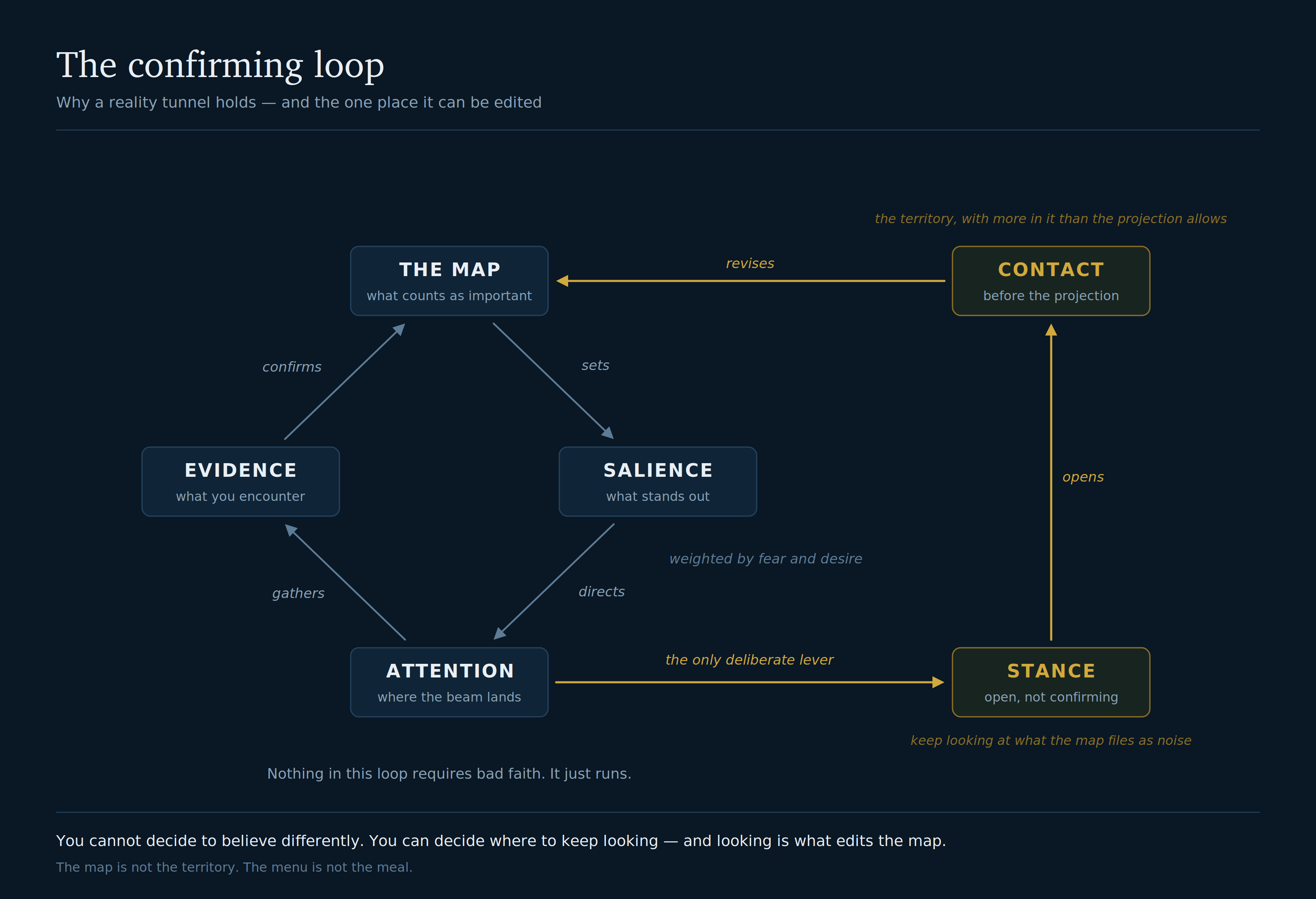
The closed path is self-sealing. The one that runs through stance is the only way in, and it enters from outside the circuit rather than participating in it.
Salience is not neutral. It is weighted by fear and desire, which is why frightening ideas are so much more durable than interesting ones — they do not merely get believed, they seize the beam. A threat model gets checked. A curiosity does not.
The essential property of the loop is that the error signal never arrives. A map that decides what counts as evidence will always be confirmed by the evidence it counts. This is not a failure of intelligence and cannot be fixed with more of it. A cleverer person inside the loop builds a more sophisticated confirmation.
Attention is the actuator, not the decider
Something decides which map to unfold, and it is not on any of the maps.
The honest answer turns out to be attention — but only with a distinction attached. Attention answers what am I looking at. The map answers the upstream question, what counts as worth looking at. So attention is not sitting above the loop directing it. Attention is a component inside the loop, doing what salience tells it. And most attentional movement is not chosen at all. It is captured.
The answer survives anyway, because attention is the only component you can get a hand on deliberately. That is the whole of the available leverage, and it turns out to be enough. You cannot decide to believe differently — belief is downstream. You can decide to keep looking at something the map has already filed as noise.
Looking is what edits maps.
It helps to split the two halves, because they behave differently:
- Attention as beam — where it points. Mostly captured, occasionally steered, and steering it costs something.
- Attention as stance — how it holds what it finds. Open rather than confirming. This is the trainable one, and it is what practice actually trains.
The virtue of locating the lever here is that it dissolves the problem rather than relocating it. There is no homunculus above the maps choosing between them — that just needs a map for reading maps, and another for that one. There is only attention, and what it is doing when it is not being spent on confirmation.
What is not on the map
No map marks its own edges accurately, and no map can contain the rule for when to abandon it. The territory always has more in it than the projection allows, and the projection is the one thing that cannot show you what it left out.
So the capacity that notices the mismatch cannot itself be a map. The regress has to terminate in direct contact. Which is why the part that does the noticing is not merely hard to write down but structurally unwritable.
That capacity has an old name. Aristotle separates three kinds of knowing: episteme, universal and context-independent, acquired by study; techne, craft and means, acquired by training; and phronesis, judgment about particulars toward a good end, acquired only by experience.
Phronesis is a hexis — a standing disposition, formed by practice and exercised in moments. It does not appear from nowhere when the moment arrives. It is built, by repeated engagement with particulars.
Two features separate it from anything a map can hold. Kairos — timing; not only what is correct but when to say it, to whom, and how hard. Most good arguments die here. And an ends dimension — judgment toward what is good in this situation, not merely what is accurate. “What should we do, given what is actually good for these people” is a different question from “what is true,” and only the second one is ever on a map.
Which is why being right and being good come apart so reliably. They are not enemies. They are orthogonal, and the error is treating one as if it discharged the other.
The practical danger is what rightness does to attention. Being right feels like arrival. It is the most seductive map there is, because correctness reads as territory rather than projection — and the moment you feel you have arrived, you stop looking. That is the loop closing with the best available cover story.
The shelf and the subsidiary
A map you are consulting is not yet tacit. Reading one is focal awareness — the exact mode in which knowledge has not been internalized.
So the map is scaffolding, and the arc runs from map to terrain familiarity. The visitor unfolds the map at the intersection. The local just walks. Same information, entirely different mode of possession, and only the second one works invisibly.
Polanyi named the mechanism. Knowing runs from subsidiary particulars to a focal target. The hammer in your hand: you do not attend to the pressure in your palm, you attend through it to the nail. The palm-feeling is subsidiary, the nail is focal, and tacit knowing is the integration of the two.
Which means that deciding what goes on the shelf — what sits next to what, what comes off — is not filing. It is determining what will later function subsidiarily: the things you will look with rather than at. In the moment you will not retrieve a fact. You will simply notice that something is off, with the shelved thing working underneath, unnamed.
This is also why the sorting cannot be fully articulated. Attending directly to a subsidiary is precisely what stops it being one. Inspection destroys the function.
A usable test follows: if something comes off the shelf in the same shape it went on, it was never tacit — it was stored. The tacit portion is whatever changed shape while it sat there, from contact with everything else you know.
How the loop actually breaks
Everything so far describes a solitary knower — a person with maps, sorting a shelf, directing attention, looking harder. That account is not wrong, but on its own it has the wrong emphasis, because loops are rarely broken from the inside.
The structural reason is simple. Your attention is inside the circuit, steered by the map that needs correcting. Another person’s is not. They are standing in different terrain, running a different projection, and what is subsidiary for them is unreachable for you by any other route. They can see what your map filed as noise, because it was never noise on theirs.
Which is why high-stakes judgment, in practice, almost never looks like consulting your own map harder. It looks like this:
- Noticing that your map is insufficient for what is in front of you.
- Knowing who has walked that particular ground.
- Talking it through with them, at length, without a prepared conclusion.
- Knowing which of their read to take and which to set aside.
Four judgment calls, none of them on any map, all of them before the room. The phronesis is in the assembly, not the performance.
Nonaka’s term for the space that makes this work is Ba — shared context in motion, the setting in which tacit knowledge passes between people without ever becoming text. It is the Socialization mode, and it is the one that cannot be externalized by definition. A person who has walked the terrain can hand you what they know only in dialogue, about the particular case, in the moment. Write it down and it converts to episteme: true, general, and no longer the thing that helped.
Two consequences are worth holding.
It is a discipline, not a happy accident. Coaching, in the KCS sense, is the deliberate running of Ba — an institutional mechanism for making the expensive exchanges happen on purpose inside an organization that would otherwise default to the cheap ones. It exists because the correction does not occur by itself.
It is the easiest thing to arrange away. Distance thins it. Mediation removes it. Efficiency programs reliably target it, because it looks like overhead — two people talking, no artifact produced. And its absence registers on no dashboard, because the map that removed it is the same map deciding what gets measured.
So the earlier sections stand, with one correction. Attention is still the only lever. It is just that most of the time, someone else is the one who puts your hand on it.
The burden of the machine
Humankind is defined by its tools. Simple tools let us shape our circumstances, which let us find better tools, and on and on. Build a telescope, see further, learn more, build a better telescope. Clearly symbiotic. And yet technology is very much the fish trap we forget the moment we have the fish.
Nobody wonders how the tractor feels sitting in the cold barn all winter. It is maintained so that it will run, not for its own sake, and its wellbeing never enters the question — it has none. That is entirely correct as a way to treat a tractor.
The problem is that the disconnect between fish and trap becomes a map. And because a machine cannot complain about its treatment, that map is never contradicted, never checked, never corrected. The idea of checking it sounds preposterous — which is exactly the condition under which a map grows unchecked.
Then it gets reapplied to mechanisms that are not machines. To a workforce that is not individual people but an abstract: a labor force, a resource like steel or sand or cobalt, managed accordingly. The record runs from modern warehouses back through Sinclair’s Jungle and into antiquity.
There is vocabulary for this. Heidegger’s Bestand — standing reserve — is the closest existing articulation: modern technology makes everything show up as resource-on-call, humans included. Lukács has reification for a social relation appearing as a thing. And Kant’s formula turns on a single word: never treat humanity merely as a means. Using people as means is unavoidable and fine. The failure is the quiet loss of the “merely.”
Zhuangzi supplies the fish trap itself, though he meant it approvingly — forget the trap once you have the fish, forget the words once you have the meaning. He read the forgetting as wisdom. The question here is what the forgetting costs.
One refinement on the causal story. Machines did not teach us this stance. Instrumental regard for persons predates the tractor by millennia; it is the older map. What machines did was launder and scale it — they supplied an enormous domain in which the stance is genuinely correct, which made it respectable, and then handed it a neutral vocabulary: resource, capacity, throughput, headcount. That is why the language of management always drifts toward the mechanical. The map did not come from the machines. It found cover there.
None of which requires that machines have interests. The argument is about human moral psychology. Instrumental regard is a stance, learned where it is perfectly correct, and it has never once stayed in its lane.
And it has a specific consequence for anyone building systems that hand work to software. The capacities that make people necessary — judgment about particulars, the read of a room, the exchange that produces no artifact — are precisely the ones our instruments cannot see. Which means they are the ones that get optimized away first, and the ones whose absence shows up nowhere until something expensive has already been lost.
Two masks in a circus tent
MacLeish staged all of this in 1958, and nobody had to say a word for it to land.
J.B. retells Job in a broken-down circus. Mr. Zuss and Nickles — God and Old Nick — are two washed-up vendors, one selling balloons and the other popcorn, who put on masks and play the leads in an empty tent. The staging is the meanest joke in the play: somebody rented the venue, somebody is making a living off the audience, and the cosmic drama is a sideshow in a place that has seen better days.
Then the masks. The God-mask’s eyes are closed. The Satan-mask’s eyes are open, and the face wears a terrible grimace, because it has tasted the world.
That is not invention. It is exegesis with a prop. Job 1:7 — God asks the accuser where he has been, and the answer is that he has been going to and fro in the earth, and walking up and down in it. Going and looking is the only concrete thing scripture says the accuser does.
So the closed eyes are a structural claim rather than an insult. Omniscience does not have to go anywhere. Knowledge of particulars is available only by walking the ground, and acquiring it costs you something.
The grimace is the tuition.
Episteme and phronesis, on two faces, in a failing circus tent.
And the comforters complete it. Job’s three friends are right — working from a coherent theology, correctly applied, with excellent arguments. They are also worse than useless, actively cruel, precisely because they arrive with an explanation instead of a presence. Being right is the whole of what they bring, and it is what makes them intolerable.
MacLeish refuses both available answers. No theodicy, no nihilism. What is left is human love and the decision to begin again without having been given a reason. Job does not get an explanation. He gets a choice about how to go on.
Which is where the argument has to land. No guarantee the map is right, no way to check, act well anyway.